
A Short Guide to ADCP
A Short Guide to ADCP
Have you ever wondered if the flow of rivers and oceans could be mapped as clearly as wind patterns in a weather forecast? In the world of hydrology and ocean science, a remarkable tool turns this vision into reality: the Acoustic Doppler Current Profiler, or ADCP.
What is an ADCP?
The ADCP is the "listener" of currents in seas and rivers. Unlike traditional mechanical current meters that measure flow point by point, the ADCP operates on a brilliant principle: the Doppler Effect.
We experience this effect in everyday life: when an ambulance with its siren on approaches us, the pitch sounds higher (frequency increases); as it moves away, the pitch lowers (frequency decreases). The ADCP harnesses this exact principle. It emits pulses of sound at a specific frequency into the water. These sound waves bounce off tiny particles suspended in and moving with the water—like sediment or plankton. The frequency of the returning echoes shifts slightly (the Doppler shift). By precisely measuring this change, the ADCP calculates the speed and direction of the water flow.
The real magic lies in profiling. Since sound echoes back from different layers of water at different times, the ADCP can analyze these returning signals to measure the velocity at numerous depths simultaneously—from the instrument all the way to the surface or seabed. In one sweep, it captures a complete vertical snapshot of the current. It’s like taking a dynamic, color-coded "photo" of the invisible flow structure.
What Can an ADCP Do?
The advent of ADCP technology revolutionized flow measurement. Its applications span rivers, lakes, and oceans:
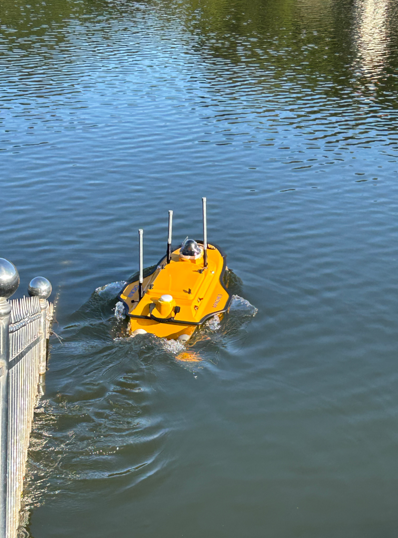
River Discharge Measurement: Replacing labor-intensive traditional methods, an ADCP mounted on a moving boat can quickly and accurately measure a river's total flow in a single crossing. It's an essential tool for hydrologists managing water resources and predicting floods.
Ocean Circulation Studies: Scientists mount ADCPs on the seafloor, buoys, or ship hulls to monitor ocean current structures, tidal movements, and complex internal waves. This data is crucial for climate research and maritime safety.
Port & Waterway Management: ADCPs provide real-time, three-dimensional current maps around ports, enhancing navigation safety for large vessels and helping analyze sediment movement for dredging operations.
Hydropower & Engineering: They monitor flow patterns at dam intakes/outlets and around structures, optimizing energy production and ensuring operational safety.
Looking to the Future
From compact portable models for mountain streams to robust deep-ocean systems, ADCPs continue to evolve. They are being integrated into autonomous underwater vehicles (AUVs) and permanent observatory networks, pushing the boundaries of how we monitor our planet's vital water systems.
In essence, the ADCP acts as our underwater ears and eyes. By translating the "whispers" of moving water into precise data, it unveils the hidden dynamics of aquatic environments, providing invaluable insights for science, industry, and environmental stewardship.